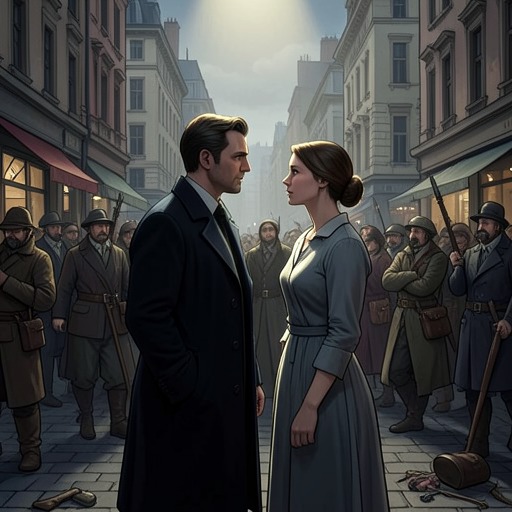
“Join with us your brothers” letter
The DispossessedThe “Join with us your brothers” letter is an unsigned appeal from Urrasti dissidents that Shevek discovers hidden in the pocket of a new winter coat. It breaks through the privileged isolation surrounding him, making his complicity in the society hosting him newly visible and sharpening his resolve to share knowledge as a gift rather than allow it to become private property.
The letter and its concealed arrival
Shevek finds the letter in a pocket of the fleecelined coat he had ordered for winter from a shop on what he calls the nightmare street. Its arrival is mysterious: he does not know how it got there, and it was not among the mail delivered to him three times a day. That regular correspondence consisted of scientific manuscripts and reprints, invitations to receptions, and messages from schoolchildren. The dissidents’ note, by contrast, is a flimsy piece of paper folded and stuck to itself, without an envelope, stamp, or mark from any of the three competing mail companies.
The contrast in its delivery matters. The ordinary mail confirms Shevek’s prominence and connects him to the world of scientists, hosts, and admirers; the unmarked note comes from people absent from that privileged circuit. Its concealment in a coat makes the appeal an intimate interruption of the comfort he has accepted, rather than another public invitation or professional communication.
An appeal from the excluded
The writer asks whether Shevek is an anarchist who works with the power system betraying his world and the Odonian hope, or whether he has come to bring that hope to Urras. The letter speaks from suffering under injustice and repression, regards the sister world as a light of freedom, and urges him to join his brothers. It offers no name or address, so its authors remain unidentified and Shevek has no immediate route to answer them.
The appeal recasts his visit. Shevek had already described himself as the Beggarman: he came without money or gifts because his society does not use money and he cannot bring anything the Urrasti lack. On Urras, however, he has received shelter and provision as an honored guest. The letter exposes the political difference between that personal hospitality and solidarity with those living under the system’s injustices. Being welcomed by the powerful has not, by itself, brought him into contact with the people who address him from outside their circle.
Recognition and the wall
The note shakes Shevek morally and intellectually. It does not surprise him that dissidents exist; what unsettles him is that he has not met one or even seen one, and has not yet met a poor man. He recognizes that he has let a wall be built around him without noticing, accepted shelter in a manner he associates with propertarianism, and been co-opted, as Chifoilisk had warned.
Recognition does not immediately solve the problem. Shevek does not know how to break down the wall or where he could go if he did; panic closes in as he realizes he is surrounded by the smiles of the rich. The letter therefore functions less as a map to an organized opposition than as evidence of the isolation built into his reception. It makes the absence of the poor from his experience legible as a political condition, not a coincidence.
From appeal to a gift
The letter’s challenge resonates with Shevek’s stated purpose in coming to Urras. In confronting Chifoilisk, he says he came to bargain with the society’s profit economy: he wants his people to come out of exile, the wall between Urras and Anarres to come down, and free exchange and human solidarity between the worlds. He distinguishes his work on Urras from his efforts on Anarres, describing the former as bargaining and the latter as acting. The dissidents’ appeal forces the distance between that objective and his protected circumstances into view.
Later, speaking with Keng, Shevek asks whether there is an alternative to selling and whether a gift is possible. He wants to give his theory to Keng, Hain, the countries of Urras, and the other worlds, so that no one power can use it to dominate others, enrich itself, or win wars. He refuses to wait for truth eventually to serve the common good, insisting that he has one lifetime and will not serve a master. The anonymous letter does not itself direct this decision, but its demand that he bring the Odonian hope establishes the human and political question that his offer answers: whether knowledge will reinforce power or become common property.